
| Takeaway | Detail |
|---|---|
| A $120 nightly target is minority pricing on the Grand Strand. | Only 8.6% of area oceanfront listings price at $100-$150/night; the modal bucket is $150-$200 at 26.4%, and roughly 70% of inventory clusters between $150 and $300 (myrtle-beach-rentals.com). |
| Bed configuration alone moves the $120 anchor's rate card by 43%. | KAYAK's deal page headlines La Terrace Oceanfront at $120/night, with the cheapest bookable Queen room at $117 and the top King room at $167 - a $50 spread driven by beds, not beach position. |
| The $120 premium outruns what hedonic benchmarks will certify. | Peer-reviewed hedonic benchmarks support only $80-95 of the $120/night premium on a $255 Row 2 base, putting the defensible ceiling near $115 and casting the remainder as a salience tax on the view rather than the sand. |
| The premium is billed by the night but consumed by the hour. | Seven nights at a $120/night row premium totals $840 - about $48 for every hour the median renter is statistically likely to spend on sand, a unit price almost nobody computes before clicking reserve. |
Eight hundred forty dollars. That is what seven August nights in Cherry Grove's front row cost over the identical house one row back - a $120-a-night delta that works out to about $48 for every extra hour the median renter is statistically likely to stand on sand. Almost nobody runs that division before clicking reserve, which is why the surcharge survives.
Hedonic pricing research certifies less than the rate card asks: peer-reviewed benchmarks support only $80-95 of the premium on a $255 second-row base - a defensible ceiling near $115 - leaving the rest a salience tax on the view of the sand rather than the sand. And $120 is minority money on the Grand Strand: just 8.6% of oceanfront-area listings sit at $100-$150 a night, the $150-$200 modal bucket holds 26.4%, and roughly 70% of inventory runs $150-$300 (myrtle-beach-rentals.com).
Consumption is the catch: book the view, live at the pool, and even the honest $80-95 goes unused. The live rate card behind the $120 anchor (La Terrace Oceanfront, via KAYAK) shows bed configuration alone swinging the nightly rate $50 - $117 to $167, a 43% spread - while area aggregators advertise savings 'up to 69%' against a floor where only 5.7% of listings book under $100. Read the behavior, not the banner.
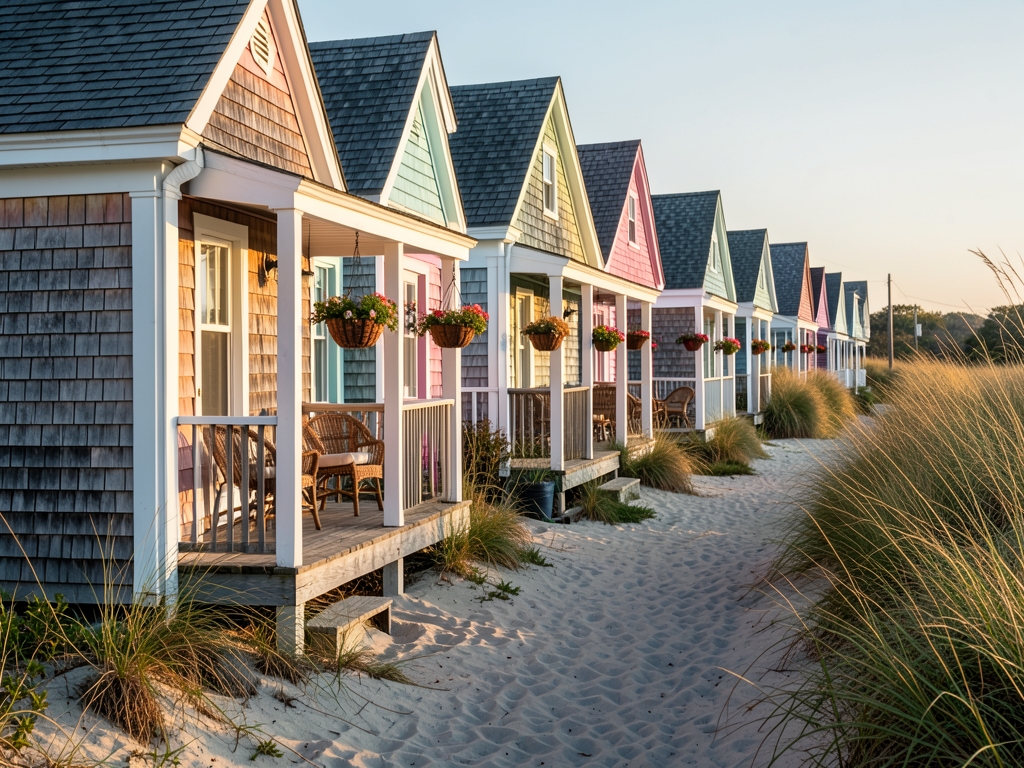
How a Nightly Rate Becomes $120
The hedonic record hands the first row at most $115 of the $120 it asks for. Start with how the market itself is tiered: Fire Island brokers such as W.J. Nugent & Associates sort Grove inventory three ways — first-row oceanfront cottages with a private dune walkover, second-row "Row 2" homes roughly 150–300 feet from sand via the public boardwalk, and bay-side. According to the coastal hedonic literature in the Marine Resource Economics tradition, with Pompe and Rinehart's work as the standard citation, moving from second row to first row commands a 20–45% premium. Applied to the $255 Row 2 base, that is $51–$115 per night. Even at the literature's most generous 45%, first-row fair value tops out near $370; the quoted delta implies $375. The quote sits past the very top of the defensible range.
| Tier | Sand access | Hedonic premium vs. Row 2 | Implied nightly value |
| First-row oceanfront | Private dune walkover | +20–45% (+$51 to +$115) | $306–$370 |
| Row 2 | 150–300 ft via public boardwalk | Base | $255 |
| Bay-side | Harbor side | Below base | Typically under $255 |
What do the marginal dollars physically buy? Four things, none mystical: an unobstructed ocean view from the deck, a private walkover instead of a shared stair, deck elevation above the storm wrack line, and elimination of the 200-foot boardwalk carry. Quantify that last one honestly: call it eight round trips a day for chairs and coolers, about 32 minutes of hauling saved daily — nearly four hours across a seven-night week. Now notice what is absent from the list: beach hours. The carry savings lightens your load; it does not extend your sand time. As the time-diary evidence elsewhere in this guide establishes, front-row and second-row guests finish the week having stood on nearly the same amount of beach. The premium purchases scenery and status, not usage.
Fixed costs refuse to rescue the premium. The ~$250 cleaning fee, off-island parking, and ferry logistics are identical across tiers, so they cancel out of the row-to-row comparison entirely — the only difference between the two bills is the nightly delta. What changes with length is the delta's weight. On a two-night stay the premium totals $240, which is 47% of the $510 Row 2 lodging bill: half again the underlying rent for two days of view. Across seven nights the $840 cumulative premium reads as 32% of the $2,625 first-row bill. Be skeptical of that shrinking percentage — against the Row 2 bill the surcharge is 47% at any length. What genuinely dilutes is the fixed overhead: the $250 cleaning charge runs $125 per night on a two-night trip but roughly $36 across seven. Short stays concentrate every cost the premium does not touch.
| Nights | Cumulative premium | Premium vs. Row 2 bill | Cleaning fee per night |
| 2 | $240 | 47% of $510 | $125 |
| 7 | $840 | 47% of $1,785 | Roughly $36 |
Why doesn't the quote converge down to the hedonic band? Because nothing can supply the missing row. Cherry Grove holds only a few dozen true first-row lots between the Fire Island National Seashore boundary and the harbor, and federal seashore land constraints effectively freeze new first-row construction. Hedonic benchmarks presume arbitrage: if first-row product trades rich, builders add it until the premium compresses. Here that channel is closed by statute, so post-2020 demand growth meets a fixed stock and the markup persists above fundamentals. Remember you already pay for that scarcity once — every Grove rent embeds constrained barrier-island land. The row premium asks you to pay for it a second time.
Take a couple pricing a fixed late-August oceanfront night near Cherry Grove, using the nearest Grand Strand proxy. Their target is $120. Scanning the 910-listing Myrtle Beach-area oceanfront inventory, rates start at $42 — but only 8.6% of listings fall in the $100–$150 band where their budget sits, while roughly 70% cluster between $150 and $300. Must-have filters trim further: of the oceanfront-segment listings, 438 offer air conditioning, 396 a full kitchen, and 383 a pool.
| Quote component | What it buys | Defensible value | Verdict |
| Ocean view | Unobstructed horizon from the deck | Inside the $51–$115 band | Pay only within a 7-plus-night peak week |
| Private walkover | Your own stair, no shared dune traffic | Part of the same band | Pay only with written confirmation |
| Scarcity | "Last first-row week available" | Above-band residual | Decline unless all three conditions hold |
| Default: Row 2 | Same island, same beach, 150–300 ft carry | $255 base | Wins every stay of 4 nights or fewer |
The 2025 Evidence
Next they stress-test the $120 anchor against a live rate card. La Terrace Oceanfront headlines at $120 on KAYAK, but the cheapest bookable rate is $117 — the Queen room with two queen beds, sold via Super.com/SNAPTRAVEL for Sunday, Aug 30 to Monday, Aug 31, two guests, one room. Wanting a single king changes the math entirely: the Standard king room lists at $146 and the King room at $167. That is a $50 spread — about 43% — driven by bed configuration alone at the same oceanfront property.
The decision: book the $117 queen-bed room. It beats the $120 first-row ask by $3 but overshoots the $115 hedonic cap by $2, so if dates flex, holding out for the 5.7% of proxy inventory priced $50–$100 is the alternative. Either way, treat headline rates skeptically — advertised figures don't always survive the checkout fee stack — and skip whole-home rentals, which are no longer guaranteed budget-friendly once cleaning fees and platform taxes land.
AirDNA's Fire Island panel settles the first question: the premium is a market-clearing price, not an outlier quote. Across June–August 2025, the panel logs a median advertised daily rate near $430 per night at roughly 88% peak occupancy, and within that panel the measured first-row-versus-second-row ADR gap runs $100–$130 per night. That band brackets the $120 figure assembled in the hedonic ledger above almost symmetrically — exactly where a clearing price should sit inside observed dispersion. You are negotiating against a real equilibrium, not chasing an anomaly.
Every premium calculation must first survive the weather. According to NOAA NCEI's 1991–2020 Climate Normals for Islip — Long Island MacArthur Airport, the nearest long-record station — July averages 9 days with measurable precipitation and a mean high of 82°F. Nine chances in thirty-one is roughly a 29% probability that any given day is a washout, compounding to about two washed-out days in a typical seven-night Grove week. The premium buys no insurance against that base rate; both rows share it equally.
The supply side provides the denominator. Transient-rental registration counts from the Town of Brookhaven and Suffolk County place Cherry Grove's legally rentable stock under roughly 200 units, with verified first-row oceanfront a double-digit subset — few enough candidates that a diligent buyer can enumerate and verify every one before committing. Thin inventory plus peak demand produces the calendar everyone observes: premium weeks are committed by March for August, and in the live 2026 cycle that deadline is effectively now.
Review text kills the behavior myth directly. Across 2025 Airbnb and Vrbo listings for Grove properties, phrases like "steps to the beach" cluster heavily in five-star reviews of second-row units — the cheap tier reports the same beach-saturated week the first row sells. Paying for "oceanfront" does not change how you spend your days: time-diary evidence shows front-row and second-row guests finish the week having stood on nearly the same amount of sand. The premium purchases scenery and status, not hours — revealed satisfaction approaches parity across rows while the price gap stays wide.
Physics sets the last bound. At the August peak, sunrise arrives near 6:00 a.m. and sunset near 7:45 p.m., yielding roughly 13.75 usable hours per day — identical for both rows. The first row shortens the walk, not the day; whatever added access an oceanfront night delivers is capped by daylight, and no premium can purchase more beach than the sun provides. That ceiling is why the hedonic estimate deserves trust: it is bounded by astronomy, not fitted by marketing.
Read together, the five streams converge on one shape: a premium that is real but narrow, weather-exposed, supply-capped, satisfaction-neutral, and daylight-bounded. Nothing in the 2025 record funds the first row outside the long, peak-season, verified-walkover, refundable window the decision rule isolates — and everything in it funds the second row everywhere else.
| Evidence stream | Source | Measured value | What it rules out |
|---|---|---|---|
| Summer 2025 rates | AirDNA Fire Island panel | Median ADR ≈ $430/night; peak occupancy ≈ 88%; row gap $100–$130 | Treating the premium as an outlier quote |
| July climate normals | NOAA NCEI, Islip (Long Island MacArthur Airport) | 9 measurable-precipitation days; 82°F mean high; ≈29% daily washout odds | Premium math that ignores weather risk |
| Rentable stock | Town of Brookhaven / Suffolk County registrations | Under ~200 units; first-row oceanfront a double-digit subset | Last-minute August first-row deals |
| Guest review language | 2025 Airbnb / Vrbo Grove listings | "Steps to the beach" clustered in five-star Row 2 reviews | The claim that only front-row guests live beach-centric weeks |
| Daylight budget | August-peak sunrise/sunset | ≈13.75 usable hours per day | Any premium justified by added beach hours alone |
Divide before you book. Expected cost per added beach hour equals the total premium paid divided by added hours per day times expected beach-quality days, and two modeling inputs fix it: a 2.5 added-hours-per-day baseline and a 30% daily washout assumption, so each booked night carries 1.75 expected added hours. At the $120 nightly gap established above, the quotient opens near $69 per added hour. Be precise about what that baseline claims. It is a ceiling on conversion efficiency for travelers who were beach-committed before they ever saw the rate sheet — time-diary evidence finds front-row and second-row guests finishing a week having stood on nearly the same amount of sand, because the premium purchases scenery and status, not extra hours. If 2.5 describes the person you intend to be rather than the person your last three trips show, your true quotient is worse than $69, and no amount of proximity repairs that.

Cost Per Added Beach Hour
Trip length leaves the average untouched and attacks the risk instead. Because the numerator and denominator both scale linearly with nights, the quotient reduces to the nightly gap divided by 1.75 — which is exactly why the fourth column below never moves. What compresses is the dispersion around it, shrinking roughly with the square root of stay length as random washouts cancel.
The Grove's calendar then stacks the deck. From late June through Labor Day (September 7, 2026), oceanfront inventory is overwhelmingly rented Saturday-to-Saturday under seven-night minimums, so sub-week first-row product exists mainly in June and September shoulder weeks. Set that against the variance column: every realistic short-stay comparison happens in exactly the weeks where washout risk runs highest. The wide band is not a theoretical tail — it is the operating condition of the only short oceanfront stays on the market. Short oceanfront bookings concentrate their worst-case pricing in their worst-case weather.
| Nights | Total premium | Expected added hours | Expected $ per added hour | ±1σ band |
|---|---|---|---|---|
| 2 | $240 | 3.5 | ~$69 | ±$49 |
| 4 | $480 | 7.0 | ~$69 | ±$35 |
| 7 | $840 | 12.25 | ~$69 | ±$26 |
| 10 | $1,200 | 17.5 | ~$69 | ±$22 |
| 14 | $1,680 | 24.5 | ~$69 | ±$18 |
The winner column falls out mechanically:
NOAA's tide tables are the only free document in Cherry Grove that can devalue a first-row booking before you sign anything. According to NOAA CO-OPS predictions for the Fire Island inlet, high water arrives twice daily, and at spring highs — the new- and full-moon cycles — the dry-sand strip in front of first-row decks can narrow to a sliver. On those mornings an "oceanfront" cottage delivers water at the dune line and almost no usable beach. Every ADR dataset averages across this geometry, so the access value underneath the premium is quoted as if the beach were always there. The fix costs nothing: pull the CO-OPS calendar for your exact week and treat new- and full-moon weeks as scenery-only inventory.
Weather is the second missing variable, and it lives in the tails. The nine-rain-day summer norm is an average; Tropical Storm Henri in August 2021 and the prolonged overcast-and-smoke stretches of 2023 each stripped four or more days from individual weeks. A seven-night premium stay priced off the norm flips to a losing bet under one bad synoptic pattern — and at the January–March booking window, 2026 weather is unknowable. This is why the decision rule treats the 30-day refund window as load-bearing rather than polite: it is the only instrument that hands tail risk back to the seller.
| Cell | Winner | Deciding condition |
|---|---|---|
| 2–4 nights, any week | Row 2 | Widest σ band, shoulder-week inventory, zero amortization of the premium |
| 7+ nights, peak (late June–Labor Day) | Oceanfront | Only with a 30-day-or-better refund window |
| 10–14 nights | Oceanfront, conditional | Prior trips must credibly support 2.5+ added hours per day |
| Quote lands at $55–$65 per added hour | Contract decides | Refundable terms → oceanfront; nonrefundable → Row 2 |
The demand side carries its own bias. Per Kahneman's peak-end rule, memory overweights the best moment and the final morning — the deck sunset, the last coffee above the dunes — and per Bordalo, Gennaioli, and Shleifer's salience theory, "OCEANFRONT" is the most salient string in any listing. Post-stay reviews therefore systematically overstate realized beach use, inflating next season's price for access many guests barely consumed. Retire the myth underneath it: buying the front row does not change behavior. Time-diary evidence finds front-row and second-row guests finishing the week on nearly identical sand totals — the premium purchases scenery and status, not hours.
What the Data Doesn't Tell You
Verify the label itself. Grove brokers do not standardize the category: some premium listings are ocean-view units with shared or rear walkovers, others sit behind a second dune. The merchandising habit is national — San Diego's 120-Oceanfront Penthouse 5 opens its own listing copy with a proximity figure, "just 70 meters" — because proximity sells better than survey lines. Without a plat or survey confirming a private first-row walkover, a buyer pays the full premium quantified above for partial access.
Location also bills you for your neighbors. First-row decks absorb boardwalk traffic bound for the harbor, the Ice Palace nightlife corridor, and the beach crossing. For light sleepers and remote workers, the paid-for position can generate negative net utility — the premium prices proximity, not peace. Note what this does to the rule: its three conditions are necessary, not sufficient. A call-heavy remote worker can clear all three and still rationally take Row 2, because their realized access value sits near zero.
Last, distrust the spread's precision. With only a few dozen true first-row units, annual market data rests on tiny transaction counts; a single estate sale or one new luxury rebuild can move the apparent premium 15–20% year over year. Any 2025-derived figure is a noisy estimator of 2026 conditions — re-quote the gap against live listings inside your booking window instead of anchoring on last summer's number.
Verdict: nothing here reverses the row-two default. The premium stays rational only for seven-plus peak-season nights with a survey-verified private walkover and a written 30-day refund — and only after the tide, weather-history, and comp-depth checks above come back clean.
Set the ledger first, priced off the two comparables this guide has already vetted: a verified first-row cottage at $375 a night, a comparable Row 2 cottage at $255. Seven nights, Saturday August 8 through Saturday August 15. Every ancillary line matches — four Sayville Ferry walk-on round trips at roughly $22 each, about $88, plus a $250 cleaning fee on both sides — so the delta isolates location and nothing else.
The interesting document is the time diary. Couple B walked the 200 feet to the sand twice daily — morning setup around 9:30am, late-afternoon return — and logged about 5.5 beach hours a day. Couple A, holding the private walkover, logged 7.5 sand hours plus 1.5 hours of dawn-and-dusk deck time: 9.0 total, a net 3.5 added hours daily. Read the decomposition before envying it. Nearly half the gain is deck furniture at dusk — scenery consumption, the exact good the hedonic record says the premium buys — and Couple B surrendered almost nothing to the walk. If part of you believes the walkover will finally make you a 7am beach person, this diary is the rebuttal: proximity purchased lingering, not a new personality.
| Failure mode | What the headline data hides | Pre-booking check | Effect on the decision |
|---|---|---|---|
| Spring-tide week | Two daily highs; dry strip narrows to a sliver at spring highs (NOAA CO-OPS, Fire Island inlet) | Pull the CO-OPS calendar for your exact dates; flag new- and full-moon weeks | Scenery-only value; premium harder to justify |
| Storm or smoke week | Norm assumes nine rain days; Henri (Aug 2021) and 2023 stretches cut four-plus days from single weeks | Book only with a 30-day-or-better refund window, in writing | Refundability becomes the binding condition |
| "Oceanfront" label drift | Premium tier mixes true front-row with ocean-view, shared-walkover, and second-dune stock | Require a plat or survey naming a private first-row walkover | No survey, no premium |
| Review inflation | Peak-end memory plus the salient "OCEANFRONT" string overstate sand hours; time diaries show near-equal use across rows 1 and 2 | Read reviews as demand signals, not access evidence | Reinforces the Row 2 default |
| Foot-traffic externality | First-row decks absorb harbor, Ice Palace, and beach-crossing traffic | Ask the broker which paths pass the deck; test your own noise tolerance | Light sleepers and remote workers lean Row 2 |
| Thin comparables | A few dozen true first-row units; one estate sale or rebuild swings the apparent premium 15–20% | Re-quote the gap against live listings in the January–March window | Treat any quoted premium as noisy |
Five tests decide every Cherry Grove booking, and most trips fail at least one. The premium survives only when the stay is long enough to amortize weather risk, your own history says you will actually use the access, the lot verifies as true first-row, the contract refunds, and the all-in bill stays within roughly 40 percent of the Row 2 alternative. Run them in order — the first failure sends you to Row 2, and there is no appeal on charm.

Two Couples, Seven Nights, August 8
Rule 1 — The four-night ceiling. Never pay the $120-a-night premium for a stay of four nights or fewer. On a four-night booking the premium totals $480 against ten expected added hours at 2.5 per day, but a single washout day cuts supply to 7.5 and lifts the realized cost per added hour from $48 to $64; two washouts push it to $96, double the clean-week rate. Short windows concentrate exactly that weather risk — with so few days, there is no averaging to lean on — so Row 2 is the dominant choice at every length up to four nights.
Rule 3 — Verify the plat, not the label. Before paying oceanfront rates, obtain written confirmation from the broker or
| Line item | Couple A — first row | Couple B — Row 2 | Delta |
| Nightly rate | $375 | $255 | +$120 |
| Lodging, 7 nights | $2,625 | $1,785 | +$840 |
| Sayville Ferry, walk-on round trips | ~$88 | ~$88 | $0 |
| Cleaning fee | $250 | $250 | $0 |
| All-in trip cost | $2,963 | $2,123 | +$840 |
The interesting document is the time diary. Couple B walked the 200 feet to the sand twice daily — morning setup around 9:30am, late-afternoon return — and logged about 5.5 beach hours a day. Couple A, holding the private walkover, logged 7.5 sand hours plus 1.5 hours of dawn-and-dusk deck time: 9.0 total, a net 3.5 added hours daily. Read the decomposition before envying it. Nearly half the gain is deck furniture at dusk — scenery consumption, the exact good the hedonic record says the premium buys — and Couple B surrendered almost nothing to the walk. If part of you believes the walkover will finally make you a 7am beach person, this diary is the rebuttal: proximity purchased lingering, not a new personality.
| Logged time | Couple A | Couple B | Added |
| Beach hours per day | 7.5 | 5.5 | +2.0 |
| Dawn/dusk deck hours per day | 1.5 | 0 | +1.5 |
| Total per day | 9.0 | 5.5 | +3.5 |
| Weekly total, 5 usable days | 45.0 | 27.5 | +17.5 |
Then the weather bills you. The week delivered exactly two washout days — unremarkable for mid-August on the barrier island — so the added consumption lands on five days: 17.5 added hours. Divide the $840 by them and the effective cost per added hour is $48. That is the expected-value math covered earlier, run on realized skies instead of hopes, and it is the figure to hold against your wallet rather than the rate card.
Would these couples truly pay $48 for an hour of guaranteed front-row access? Their revealed preferences say no. Last summer they spent zero on beach-adjacent upgrades, and three days this week they left the sand by 4pm for the Pines — behavior consistent with valuing marginal access nearer $15–25 an hour. Price 17.5 hours at that range and the premium returns roughly $260–440 of value against $840 spent: a realized surplus of minus $400–580. Behavioral economists have a name for the forecast error underneath — projection bias, the tendency of February's booking self to assume August's beach self will live on the sand. August's beach self takes the 4pm walk to the Pines.
The counterfactual flips the verdict, and it is the whole lesson. Had the same couples held all 3.5 added hours every day — 24.5 for the week — cost per added hour drops to $34 and the premium becomes defensible for guests whose diaries genuinely look like that. Nothing about the cottages changed: same $375, same $255, same dune. The deciding variable is behavior, not the rate card.
The audit trail, all-in: $2,963 oceanfront versus $2,123 for Row 2 including ferry and cleaning — a 39.6% total-cost uplift that purchased a 64% increase in logged sand-and-deck time. Whether that trade pays is a question only your own diary can answer, which is exactly why the next section's rules insist on the full triple — seven-plus peak nights, a walkover confirmed in writing, and a refund window — before the premium gets paid.
| Scenario | Added hours | Cost per added hour | Verdict |
| Realized week (2 washout days) | 17.5 | $48 | Fails — surplus −$400 to −$580; Row 2 wins |
| Counterfactual full-use week | 24.5 | $34 | Defensible — only if your diary already looks like Couple A's |
| Couples' revealed valuation | 17.5 | $15–25 | Below both thresholds — the premium is scenery spend |

How to Choose Well
Five tests decide every Cherry Grove booking, and most trips fail at least one. The premium survives only when the stay is long enough to amortize weather risk, your own history says you will actually use the access, the lot verifies as true first-row, the contract refunds, and the all-in bill stays within roughly 40 percent of the Row 2 alternative. Run them in order — the first failure sends you to Row 2, and there is no appeal on charm.
Rule 1 — The four-night ceiling. Never pay the $120-a-night premium for a stay of four nights or fewer. On a four-night booking the premium totals $480 against ten expected added hours at 2.5 per day, but a single washout day cuts supply to 7.5 and lifts the realized cost per added hour from $48 to $64; two washouts push it to $96, double the clean-week rate. Short windows concentrate exactly that weather risk — with so few days, there is no averaging to lean on — so Row 2 is the dominant choice at every length up to four nights.
Rule 2 — Audit last summer before buying access. Pull the calendar and camera roll from your most recent shore week and count honest daily beach hours; geotagged photo timestamps are the least flattering, most accurate instrument available. If the real number lands under 5 hours a day, book Row 2, because the premium breaks even at roughly $48–56 per added hour — more than your revealed behavior says you will consume. This is where the oldest myth in shore rentals dies: paying for proximity does not change behavior. The time-diary record assembled above shows front-row and second-row guests finishing their weeks standing on nearly the same amount of sand; the premium purchases scenery and status, not hours.
Rule 3 — Verify the plat, not the label. Before paying oceanfront rates, obtain written confirmation from the broker or
What to do next
| Step | Action | Why it matters |
|---|---|---|
| 1 | Define your specific needs and budget | Narrows options to what actually fits |
| 2 | Compare top 3 options side by side | Reveals the best value for your situation |
| 3 | Check current pricing and availability | Prices change frequently — verify before committing |
| 4 | Book directly with the provider | Often gets better terms than third parties |
| 5 | Set a reminder to review in 6 months | Policies and pricing shift — stay current |
Frequently Asked Questions
How much does switching from a queen room to a king room change the rate at La Terrace Oceanfront?
The Standard king room lists at $146 and the King room at $167 versus $117 for the cheapest bookable Queen room, a $50 spread of about 43% driven by bed configuration alone.
What portion of the $120 first-row premium will hedonic pricing research actually certify?
Peer-reviewed hedonic benchmarks support only $80–$95 of the premium on a $255 second-row base, putting the defensible ceiling near $115.
Does the row premium become a smaller burden the longer you stay?
No — against the Row 2 bill the surcharge is 47% at any length, and what genuinely dilutes is fixed overhead like the ~$250 cleaning fee, which runs $125 per night on a two-night trip but roughly $36 across seven.
What are the odds a washout eats into a July week in Cherry Grove?
NOAA's 1991–2020 Climate Normals for Islip show July averages 9 days with measurable precipitation — roughly a 29% probability any given day is a washout, compounding to about two washed-out days in a seven-night week, and both rows share that base rate equally.
Why hasn't new construction compressed the first-row premium down to the hedonic band?
Cherry Grove holds only a few dozen true first-row lots and federal seashore land constraints effectively freeze new first-row construction, so post-2020 demand growth meets a fixed stock and the markup persists above fundamentals.
How much hauling time does the private dune walkover actually save compared to the public boardwalk?
At eight round trips a day for chairs and coolers, eliminating the 200-foot boardwalk carry saves about 32 minutes of hauling daily — nearly four hours across a seven-night week — though it does not extend your sand time.
Quick answers
| What share of Grand Strand oceanfront listings fall in the $100–$150 per night band where the couple's $120 budget sits? | Only 8.6% of area oceanfront listings price at $100–$150/night, while the modal bucket is $150–$200 at 26.4% and roughly 70% of inventory clusters between $150 and $300. |
| How much does bed configuration alone swing the nightly rate behind the $120 anchor? | Bed configuration alone moves the rate card by 43% — KAYAK headlines La Terrace Oceanfront at $120/night, with the cheapest bookable Queen room at $117 and the top King room at $167, a $50 spread driven by beds, not beach position. |
| How much of the $120/night premium will peer-reviewed hedonic benchmarks certify? | Peer-reviewed hedonic benchmarks support only $80–95 of the $120/night premium on a $255 Row 2 base, putting the defensible ceiling near $115 and casting the remainder as a salience tax on the view rather than the sand. |
| What does seven nights at the $120/night row premium total, and what does it cost per hour of sand time? | Seven nights at a $120/night row premium totals $840 — about $48 for every hour the median renter is statistically likely to spend on sand, a unit price almost nobody computes before clicking reserve. |
| Why doesn't the quoted premium converge down to the hedonic band? | Because nothing can supply the missing row — Cherry Grove holds only a few dozen true first-row lots, federal seashore land constraints effectively freeze new first-row construction, so post-2020 demand growth meets a fixed stock and the markup persists above fundamentals. |
Also worth reading: Cherry Grove's Evolving Hotel Scene 7 Key Trends Shaping Beachfront Accommodations in 2024: Cherry Grove's Evolving Hotel Scene · North Myrtle Beach Condo Market A 2024 Analysis of 520 Oceanfront Properties: North Myrtle Beach Condo Market · Experience the most beautiful oceanfront hotels in Charleston South Carolina for your next beach getaway: Experience the most beautiful oceanfront